
This weekend’s hike was 20 km along the 25 km Schlaubetal Hiking Trail. We were unaware of the last southern five km of the trail until Saturday otherwise we would have included it. Since we didn’t know about it, we started at Bremsdorfer Mühle after two hours of trains and bus from Berlin. Really not that far to travel for some excellent hiking. We walked north from the bus stop to Müllrose. The trail mostly runs alongside the eastern side of a series of lakes. It’s easy and rather enjoyable hiking with a few small hills thrown in just to get you up to speed. It is well marked with no need of a map so you can delve into the scenery and the solitude. Like on other Brandenburg trails, we saw very few fellow hikers so we had it mostly to ourselves.
Trail to the Horizon: Werbellinsee, Brandenburg

Sarah and I did a 17 kilometer hike this weekend around Werbellinsee. Actually we did not hike the entire lake. We traveled via several trains to Joachimsthal-Kaiserbanhof. We walked south nearly along the lake but stayed in the woods to avoid the more direct but busier route along the bike path. Along the way, typical Brandenburg forest and solitude, birdsong and endless rustling in the undergrowth. We stopped for a homemade sandwich around Am Spring and then continued along the lake to have a smoked fish sandwich at Alte Fischeriei in Altenhof. Alte Fischerie is one of our favorite lunch spots: we’ve been visiting them since our earliest Berlin days.
We returned to Joachimsthal-Kaiserbanhof via the ferry that runs the length of the lake. It was an enjoyable half hour boat ride, followed by a brisk hike up the road to catch the train home. Great day in the woods!

Where Comfort Can Be Found: Published in 2019 by Prometheus Dreaming
Prometheus Dreaming, the original publisher of this short story, seems to have moved their online presence to an Instagram account but there don’t seem to be links to complete stories. I am making Where Comfort Can Be Found available here on my website. Happy reading!

Where Comfort Can be Found
by David H Weinberger
After I buried Victor, I filled his hiking boots with potting soil and Creeping Baby’s Breath, and created a sort of memorial in my garden. The faded black and gray boots, spotted with moss, sit beside a wood bench and a dusty blue watering can filled with sprightly, yellow sunflowers. The flowers have responded to my meticulous care and still flourish five years after I planted them. They are radiant and cascade over the rim of his boots. A perfect still life, worthy of any painter’s attention. But an attempt to capture it on canvas would miss the essence of the setting: the spirit of Victor.
I caress the delicate white flowers, feel the moist, succulent stems and leaves, smell the damp, musty earth in each boot. Time slips by as they comfort me, like my forty years of marriage to a vibrant, friendly, and loving man. Those years remain the most important ones of my life, so different from the slow and monotonous dragging of these days.
I lost Victor twice to the Rheinsteig hiking trail: he was constantly on it. As a child, he lived with his mother and father in the small village of Braubach beside the Rhein River, where I still live today. He hiked the steep terrain above the river with his father every weekend. His legs grew stronger, his breath more controlled, with each ascent and descent. Although he spent most of his time on the trails around the village, over his 60-years he covered all of the 320 kilometer Rheinsteig. Sometimes, he would spend hours on the train to reach one of the twenty stages. It was not until we married, that he hiked continuously from beginning to end, Bonn to Wiesbaden. From that time on he completed the entire trail once a year. The rest of the time, he returned to local parts of the trail to enjoy the sun, and even the rain. Hiking the trail was when Victor was most alive.
The first time I lost Victor I was young, silly, and newly married. I selfishly begrudged him his time on the trail. He always invited me to join him, but it was useless.
“I got you these Lowa boots.” he told me one Christmas. “So you can walk with me. Experience the trail.”
They were stiff and smelled of good leather but not really a gift I wanted. I saw them more as a gift to himself, to feel less guilty about leaving me at home.
“You know how I feel about it,” I whined back. “The exposure on the trail scares me, and besides, I don’t like walking in the woods as much as you do.”
I stored the boots in our closet: they never carried me alongside Victor on his hikes.
As the years passed, I realized he was truly a son of the trail and it brought him a pleasure I could never provide. At first, I was saddened by this realization, but slowly became resigned to it and came to accept his Rheinsteig. I took up gardening to stay busy while Victor was away. I relished tilling the damp and peaty soil in preparation for so many interesting flowers. Occasionally, I sold a few at the market, but mostly I kept them throughout the house and yard for my own pleasure.
I lost Victor the second time when he fell hiking on a section of the trail I imagined he hiked dozens of times before. His friend Karl was with him on that day and he told me with tears in his eyes what happened.
“We could barely see through the rain and fog,” he told me. “The ground was nearly invisible. We slowed down to navigate a particularly steep and rocky descent. Victor lost his footing, his grasp on the handrail, and slipped.”
“I don’t understand, he knows that trail so well.”
“It was slick and, like I said, difficult, even in good weather. He fell a long way into a ravine. I could only watch as his head kept hitting rock on the way down. He was dead by the time I reached him. Nothing I could do.”
I get nauseous when I think of his body helplessly plummeting, being abused by something he cherished so much. And not able to help him in some way.
When I collected his blood-soaked belongings, I laid them out on the bed. They were his usual hiking clothes: quick-dry shorts and t-shirt, wool socks, day pack, and the hiking boots that now sit in the garden holding the Creeping Baby’s Breath. I kept only the boots because they remind me of Victor and his passion for the Rheinsteig.
Most days, I don’t dedicate the time and energy the garden requires: with what I have, I tend the Baby’s Breath and keep fresh flowers in the watering can. Aside from that, I do nothing but sit on the bench. If I didn’t have to work in the restaurant, I would probably never leave. But, it’s time for work, so I go through the motions of cleaning myself, in a pointless attempt to become presentable. Although the shower rinses away the soil, it does nothing for my melancholy. I see this as I walk past the mirror. Thinning, lifeless hair. Dark bags under cloudy, pale green eyes. Soft, drooping jowls, and wrinkles from a constant frown. Fat arms and legs surrounding a sulking frame. Sagging breasts barely concealed by the gossamer of a thin t-shirt and a threadbare smock. No makeup or jewelry to hide any of this.
I used to look better than this sleepwalker, used to attract men. But no matter:
I lost interest in men and women years ago. Not that others haven’t approached me.
“You spend so much time alone,” a male friend told me, not long ago. “Join me for a movie, or dinner out.”
He meant well, and he lost his wife a few years back, so he knows what it is like to be lonely. All the same, I have no room in my heart for another human being.
“Thank you,” I told him. “I’m happy in my garden. I have no need for companionship.”
“You don’t seem very happy. I’m sorry to be blunt, but you seem rather gloomy. Some time away from your garden would do you well.”
I insisted, he left me in peace, and no longer visits me. What he said though, makes sense: I should leave the garden, talk to people, have a good time. Fill the endless days and empty nights with something other than sadness. But my mourning is more salient than any healing thought and I find myself trapped in my closed world.
My walk to work is usually as uneventful as my mornings at home. The flowers, the well-tended yards and houses lining Hermann Street, present an empty, gray palette. There used to be more inspiration like the Baby’s Breath and the sunflowers at home. Victor was better than I was at finding hidden gems in Braubach: the kitten hiding under a maidenhair fern, the newly painted shutters on a neighbor’s house, the scent of freshly cut pine. Without him, these things are elusive and mundane as my shower. Nothing but a dirty mess washing down the drain.
But today, outside the Kraus home, I notice something I have never seen before. At the foot of their silly gnome is an erupting patch of Creeping Baby’s Breath. The flowers are a soft pink, an unexpected splash of color. Strange that they should appear out of nowhere displaying such a vibrant pink. Surprising myself, I kneel to take a closer look and experience a joy I have not known for some time.
The feeling dissipates as soon as I leave and reach the restaurant where I will spend six hours serving schnitzel, goulash, and endless beer. The friendly customer banter, attempts at speaking to me in German, and their praise of the hearty food, falls on deaf ears and I only provide perfunctory replies. A young woman I have not seen before stands out in tonight’s crowd. She doesn’t engage me in conversation but I am drawn to her because of her gentle laughter, the gleam in her eyes, and the way she occasionally touches the others at her table, as if to confirm that she is listening and intrigued with the conversation. I think I was like her when I was younger: innocent yet vivacious, ready to ride over any bumps along the road. I don’t remember losing those qualities but I have. Somewhere in my sorrow, I became less of myself and the memory of Victor a fragile thread holding me to the little that remains.
On the way home, after my shift, the realization continues to nag leaving me exhausted. The bed that awaits me is cold and too big, so I avoid it and go to the kitchen, and look out the window at the boots, the Creeping Baby’s Breath, and the sunflowers. I have come to see this still life as Victor himself, as the power that enables me to meet the challenges of each day. But tonight, after the pink Baby’s Breath and the young woman, I am wondering how long a bunch of flowers in a pair of boots can sustain my life, can be a sufficient reason to live: their usefulness is fading.
I hardly sleep at all that night anticipating a new morning, a strange feeling after tending my grief for so long. I am greeted by abundant clutter as I rummage through the closet, but I eventually locate my unused Lowa boots, Victor’s thankless gift. The leather is dry and cracked in places, the rubber soles hardened. I struggle into them and my feet immediately feel constricted, my stomach queasy as I imagine touching trail for the first time. I ignore my growing anxiety as I search for the Rheinsteig maps. Flipping through them, I find the one with Braubach trails on it, folded from years ago so the local trails are visible.
Before leaving the house, I have a strange impulse to open the curtains: except for last night’s peering outside, they have remained closed for some time. The sunlight illuminates the rooms and exposes my lack of cleaning. The dust and confusion will have to wait.
The trailhead is well marked, next to the pharmacy. I leave the pavement and my feet land on the path that Victor knew so well. I am frightened of moving forward. I wonder how far I can walk alone, if I will avoid getting lost, if I will be overcome by the sadness that has been my only companion. But I take the first hesitant steps, small pebbles and soft pine needles beneath me. Braubach fades as I advance into a dense wood with rocky outcroppings. The air is clean, and with each breath, I feel something like life seep into me.
End
A LITTLE PARCEL OF THINGS: A NEW STORY BY DAVID H WEINBERGER

My newest story is now available in Still Points Arts Quarterly. Links on my Publications page. It’s available as a free pdf download and a purchased print edition.
Solar Bones: Mike McCormack

This is the first I have read Mike McCormack and I am quite happy I learned about this exceptional one sentence novel. The story involves the civil engineer Marcus Conway as he waits for hours in his kitchen for his wife to return home. His reflections on his family, his community and his entire life unfold in a tidy stream of consciousness narrative which he envisions as a “memorial arc which curves from childhood to the present moment.” I enjoyed the way Conway’s engineering worldview allows him to deconstruct his world to ultimately discover the “harmonic order which underlay everyone and everything.”
The novel opens with the noontime ringing of the local Angelus Bell and introduces the entry of the wider world into Conway’s ruminations. The scene immediately put me in mind of the ringing bells throughout Krasznahorkai’s novel Satantango and mirrors a similar apocalyptic vision, though much more hopeful in the present novel. It did, however, set my mood for the reading and I could hear the Angelus Bell ringing on every page, perhaps calling folks to take stock of their lives and the values we choose to uphold.
I will read more McCormack based on how good this novel is, starting with his two short story collections. Such a pleasure becoming aware of this Irish author.
Jeferson Tenório: The Dark Side of Skin

This incredible novel, translated by Bruno Dantas Lobato and published by Charco Press, explores racial relations in Brazil. Though the black experience in Brazil is distinct from that in America I often found it uncanny how similar the situation seemed: the story could easily have unfolded in any-city USA.
The second person narrative is the ‘invented truth’ or the invented ‘memory of you’ as the narrator grieves the death of his father. Along the way the story deals primarily with systemic racism but also with family dynamics, hurt people and their search for happiness, and the daily struggle of walking out the door each morning. The characters attempt to love and be loved, some seriously challenged by their shortcomings, but for me they remained sympathetic.
Though a bleak and sobering story, I found it engaging and challenging, compassionate and frustrated. A wonderful depiction of the often damaging patterns we encounter in ourselves and in society. Highly recommended.
Rebecca Goldstein: Incompleteness: The Proof and Paradox of Kurt Gödel
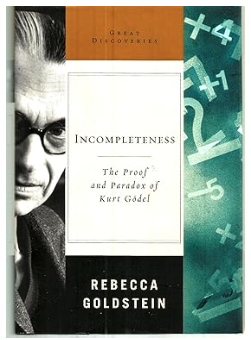
I will state right from the start that this book and Gödel’s Incompleteness Theorem are far from my full comprehension: I’m glad I read it but confess to not fully understanding most of it. I ran across the theory while reading Mircea Cartarescu’s Solenoid and was intrigued with his application of the theory and its philosophical implications. In a nutshell and in my less than mathematical thinking, I understand incompleteness to state that there are objective truths that cannot be proven within that system and that if one fails to reach an objective truth there is a fault in one’s thinking, not in the truth itself. Goldstein’s example is the statement 5 +7 = 12. If one were to add 5 and 7 and arrive at 13, one can assume there is a problem with counting and not with the statement. Clear enough, but I got lost in Chapter 3 where Goldstein lays out the proof for this. Sill, there is something inherently attractive in the theorem and in its application to daily life and it is the reason I slowly worked my way through the book.
One useful application is in evaluating the current mess of constant lies, false ‘facts,’ and the rewriting of objective truths dominant in politics and social life. Its as if we now reject the existence of objective truths in favor of anything we want to create or manufacture to justify our behaviour. People have some bizarre beliefs and opinions and create new ‘truths’ to support those beliefs and opinions, rather than the other way around. Goldstein quotes Gödel in her epigraph: “But every error is due to extraneous factors (such as emotion and education); reason itself does not err.” It seems as if reason is today’s casualty in favor of subjective truths and errors.
I may be making a mistake in trying to apply Incompleteness to daily living, and granted my understanding is tenuous, but it seems like a worthy goal. A challenging book and enlightening reading about Gödel’s life outside of mathematics, especially his relationship with Einstein. A good brain teaser.
Tom Drury: The End of Vandalism

There is a scene near the conclusion of ‘The End of Vandalism’ where a character who owns a campground is explaining to an engineer about the meandering path to the lake. He had complained that it should have been built straight. She claimed she thought it was straight. That is an apt metaphor for how I see this engaging novel unfolding. Short on plot but abounding in stories of the people living in the fictional rural-American Grouse County. Characters who see their lives as heading straight but actually meandering through highs and lows, good times and bad. The stories accumulate to paint a heartbreaking narrative of lifelong efforts to find a bit of happiness.
An aspect of the novel I particularly enjoyed was Drury’s abundant use of music, with liberal sprinkling of musician names, song titles and lyrics. The characters were steeped in music and albums and the CD appeared near the end of the novel, albeit with only one character: most others missed out on that questionable technological breakthrough. Another aspect I enjoyed was the slow decay of the rural county, its towns, and the quality of life of its citizens, summed up well by the narrator with ‘services were leaving Grafton like seed from a dandelion.’
As I read the constant vignettes, I imagined a quilt or a web slowly being built. Intersecting lives, chance meetings and near misses, more and more odd decisions and chances taken. Characters lost on their own meandering paths. A very engaging read and a wakeup call to enjoy and appreciate the journey.
Idle Hill: Available Now! in synkroniciti magazine

Idle Hill title page at synkroniciti
My short story Idle Hill is now available for purchase at synkroniciti magazine. It is a PDF download for $7.00 and includes lots of other great authors and artists and their interpretations of the theme Haunting. I have also provided a link to the magazine’s website on my Publication page. Idle Hill is my contribution to this theme and explores toxic masculinity and grieving. It would be wonderful if you could give it a read and let me know what you think. Please enjoy.
IDLE HILL: A NEW STORY BY DAVID H WEINBERGER

Synkroniciti magazine cover Fall 2024
On December 15, 2024 my short story Idle Hill will appear in the magazine Synkroniciti! The issue focuses on the theme ‘Haunting’ and I love how that theme overlaps the struggles and thoughts of my main character. When I wrote the story I was exploring toxic masculinity, specifically its generational aspects, and its devastating outcomes. Extreme thanks to all at Synkroniciti for reading my story and valuing it enough to share it in their next issue. I will announce when it is available.
Quisque iaculis facilisis lacinia. Mauris euismod pellentesque tellus sit amet mollis.