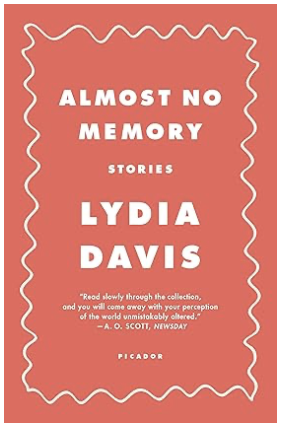
Almost No Memory, Lydia Davis, 1997. Included in The Collected Stories of Lydia Davis, 2011.
Davis’ short stories have been labeled as miniatures, prose poems, and contemplations, among other descriptors as a way to understand what she is doing in her work. I do find myself questioning what each small offering is supposed to be but ultimately it really doesn’t matter. Davis explores the inner workings of the mind as it works to make sense of relationships and reality and her form is an excellent way to do so. While sometimes confused as to the message of a particular story I was intrigued with each piece. The Thirteenth Woman, where the first twelve women completely ignore the thirteenth, is simply delightful. In Foucault and Pencil, a woman strives to understand the meaning and cause of an argument with her partner. And my favorite, The Race of the Patient Motorcyclists, reads like a paean to slowness.
There is a scene I love in a Samuel Beckett story about a character holding three pebbles as he goes through the iterations in his mind of how he can put them in two pockets one at a time: an incredible scene. Many of the stories in Almost No Memory are like this: characters thinking through the possibilities of doing a particular task but being unable to reach a conclusion. Other stories are essentially lists but read like dynamic and meaning-filled short stories.
How Almost No Memory informs my writing.
As I read these stories, I did have some confusion of what the meaning was, especially in light of the title of the collection. Ultimately, my take away is that Davis is suggesting that in our present conflicts or disagreements we have no memory of how we got into that situation or into that particular relationship with the partner we are having a conflict with: we are totally consumed with thinking through the current problem. I realize this is a simplistic interpretation but with it I was better able to process each story. And I am not suggesting that I know what Davis meant with the individual stories or with the collection as a whole. But what I appreciate is that her art is not really about a particular meaning or take away. The stories stand on their own but they also work well as a unified whole. This is what I would like to accomplish with my newest short story collection I have been putting together. My stories are about the current US political situation and the effect many of their dictates have on everyday people. I am hopeful that the stories add up to a powerful message but one that I am not blatantly proclaiming. I would like it to be as subtle as Davis’.
My story Fragility comes closest to the method Davis uses, though I am in no way comparing my work to hers: hers is a genius I will most likely never attain. In my story a mother is tormented by her son’s behavior of talking to his dead grandfather and is put off by the ‘help’ his school offers. It is a mere 1700 words and I have been told that people love it or hate it; there doesn’t seem to be any in-between. But I mention it because I feel it is short on explanations and simply presents a situation that I hope the reader will analyze independently. Fragility was first published by the now defunct Slag Review but can be found in my collection Not So You’d Notice, available at Amazon.

My story collection!
Quisque iaculis facilisis lacinia. Mauris euismod pellentesque tellus sit amet mollis.